Getting a Houston Apartment: When to Rent & How to Get Approved (2026)
Most rejected Houston renters reach for a traditional cosigner. It's path #1 of 4 — and it asks the most of someone else, builds zero renter history, and often isn't even available. The other three are real, Texas-statute-backed or 50-state-operational, and most renters have never heard of them.
At 4:12pm on a Wednesday, Lena DMs Maya: *"They rejected me. Credit's 640, they wanted 680. The application fee is gone. My mom already cosigned my brother's lease last year — she said no, she can't sign two. I don't have anyone else."*
Maya's reply was three words: **"You have Leap."**
Five days later, same building, same unit, no cosigner, no new application fee — Lena was approved. Through a third-party guarantor service called Leap she had never heard of, that operates in all 50 states, that the building had quietly accepted for two years.
This is the part of the Houston apartment search nobody talks about: the rejection isn't the end. It's the moment most renters reach for the **worst of 4 paths** — the traditional cosigner — because it's the only one they know about. The other three are real, they're verified by Texas statute or 50-state operations, and they've existed the whole time. Nobody told you because nobody made money telling you.
> **This is a journalism guide, not legal or financial advice. Statutes cited are real. Guarantor service availability and building acceptance change — confirm with the building before applying. Houston resources at the end.**
The Numbers
Distinct paths to Houston apartment approval when standard screening fails
4
Annual cosigner income required (industry 80x-rent rule) for a $1,500/mo unit
$120K
States Leap operates in — including Texas
50
States Insurent operates in — Texas is NOT one of them
10
Texas SB 1783 (2021) — fee-in-lieu-of-deposit law, codified at §92.111
§92.111
LeaseLock standard monthly fee replacing a $1,400-$2,800 deposit
$19/mo
Tenants who choose the monthly fee when offered (LeaseLock)
92%
Renters prevented from desired apartment by upfront move-in costs (Jetty 2019)
~60%
The 4 Paths at a Glance
Four Paths Out of a Houston Rejection — Side by Side
**PATH 1 — Traditional Cosigner**
- *Who it's for:* You have a willing family member with 700-750+ credit and ~80× monthly rent in annual income
- *What you give up:* Family member is on the hook for full lease + damages. Most refuse once they read the fine print.
- *Why it's usually the worst:* Asks the most of someone else, builds you zero independent renter history, often unavailable.
**PATH 2 — Third-Party Guarantor Service**
- *Who it's for:* You have decent income but thin file, sub-700 credit, or no eligible cosigner — including international/ITIN renters
- *Who provides it in Houston:* Leap (all 50 states), TheGuarantors (40+ states). **Not Insurent** — Insurent doesn't operate in Texas.
- *Cost:* Typically 5-12% of annual rent, paid by you
**PATH 3 — Texas §92.111 Fee in Lieu of Security Deposit**
- *Who it's for:* You qualify on credit and income but don't have $3,000-$5,000 saved for first+last+deposit
- *What it is:* Codified by Texas SB 1783 (2021). Replace the upfront security deposit with a small monthly fee (~$19/mo via LeaseLock)
- *Important:* Does NOT solve credit/income screening — solves the move-in cash wall only
**PATH 4 — Houston Second-Chance / Case-by-Case**
- *Who it's for:* Eviction or broken-lease in the database, sub-580 credit, or recent BK — paths 1-3 likely fail
- *What it requires:* Steady income at 2.5-3× rent, clean recent 12 months, no unpaid apartment debt, and a clear narrative of what changed
- *Caveat:* "No credit check apartments" advertised in Houston are scams — every legitimate building runs a check
Path 1 — The Traditional Cosigner (Why It's the Worst Path)
The 80× Rent Rule, the Liability Trap, and Why Most Cosigners Quietly Refuse
The traditional cosigner is the path everyone tries first because it's the only one parents and most landlords still talk about. The math is brutal once you spell it out.
**Houston Class A standard for cosigners** (verified 2026-05-01 across ApartmentList, LeaseRunner, Houston locator services):
- Credit score: **700-750+**
- Annual income: **80× monthly rent** (the industry-standard rule)
- For a $1,500/mo unit: **$120,000/year** in cosigner income
- For a $1,800/mo unit: **$144,000/year**
- No broken leases, no evictions, US resident, prefer same state
**More flexible Houston buildings** sometimes accept 650+ credit and 5-7× monthly rent (annually) — still a high bar.
**The liability trap:** A cosigner is on the hook for **full rent and damages** if you default. Not partial. Not capped. If you skip out on $4,200 in remaining rent and break a $1,200 mirror, the landlord can come after the cosigner for $5,400 — and the cosigner's credit takes the hit, not yours.
Most cosigners don't read the fine print until the lease is in front of them. Then they refuse. This is why **Path 1 fails most often after the application fee is already paid**.
**When Path 1 actually works:** parent, sibling, or spouse with strong credit and high income who's done it before, fully understands the liability, and has a written agreement with you about what happens if you can't pay. If that doesn't describe your situation — Paths 2, 3, or 4 are usually faster, cleaner, and don't burn family relationships.
Path 2 — Third-Party Guarantor Service (The Path Most Renters Have Never Heard Of)
Leap, TheGuarantors, and the Insurent Trap
A third-party guarantor service signs the lease as your guarantor — for a fee. The building gets a corporate guarantee instead of relying on a family member. You get approved without a cosigner.
**Who operates in Houston** (verified 2026-05-01):
- **Leap** — operates in **all 50 states**, including Texas. Approval based on the renter's own income, credit, and rental history at lower thresholds than typical Houston building screening. Accepts international applicants (ITIN, no SSN). Best for thin-file renters and international moves.
- **TheGuarantors** — operates in **40+ states**, likely Houston-available. Similar pricing structure.
- **Insurent** — operates only in NY, NJ, MA, MD, VA, IL, NV, CA, FL, and DC. **Not available in Texas.** If a Houston broker mentions Insurent, they're guessing — eliminate from your shortlist to avoid wasted research.
- **Rhino** — sometimes confused with a guarantor service. Rhino is actually a **security-deposit alternative** (closer to Path 3). It does NOT replace a cosigner for credit/income screening.
**What it costs:** typically 5-12% of annual rent, paid upfront or monthly to the service. On a $1,500/mo unit ($18,000/year), that's roughly **$900-$2,160/year**.
**The catch:** the building has to accept the service. Adoption among Houston Class A operators is growing but spotty — Greystar, Camden, Bell, and Trammell Crow properties accept guarantor services on a building-by-building basis. **Always confirm with the building's leasing office before applying** — "Do you accept Leap (or TheGuarantors) as a guarantor?" Five-minute call. Saves another rejected application fee.
**Why it beats Path 1:** the service underwrites you directly, not your parent. Your application becomes its own decision. You build independent renter history. And no family member becomes liable for your lease.
Path 3 — Texas §92.111 Fee in Lieu of Security Deposit (The SB 1783 Path)
Replace the $2,800 Deposit with a $19 Monthly Fee — The Texas Law That Made It Possible
Texas Property Code §92.111 (codified by **Texas Senate Bill 1783**, 87th Legislature, effective September 1, 2021) authorizes Houston landlords to offer renters a small monthly fee in place of an upfront security deposit. This is a **statutory option** — it didn't exist in Texas before 2021.
**How it works** (verified 2026-05-01 against texas.public.law/statutes/tex._prop._code_section_92.111):
1. Landlord offers you the option at lease signing — "You can pay a $2,800 security deposit, OR a $19/mo fee that funds an insurance product covering the same risk."
2. The fee is non-refundable. The deposit is (theoretically) refundable.
3. **Anti-discrimination clause built into the statute:** if the landlord offers the fee option, they MUST also offer the traditional deposit option, and they CANNOT use your choice as a screening criterion against you.
4. The fee funds a property-side insurance product (LeaseLock is the most common in Houston; Jetty also operates in this category).
**LeaseLock standard pricing in Texas:** **$19/month**. On a $1,400/mo Houston unit, that's $228/year — vs the $1,400-$2,800 you'd otherwise tie up upfront.
**LeaseLock-published adoption stat:** when offered, **92% of tenants choose the monthly fee option**. The number is high because move-in cash is the gating constraint for most renters who could otherwise qualify.
**What it does NOT do:** Path 3 does **not** solve credit or income screening. If you can't qualify on credit/income, the fee-in-lieu doesn't help — you need Path 2 or Path 4 instead. Path 3 only solves the move-in cash wall.
**Who Path 3 is for:** the renter who is income+credit-approved but doesn't have $3,000-$5,000 saved for first+last+deposit. This is Maya's classic OA-03 problem — the "I qualify but I'm broke" wall.
**The ask:** call the building before applying — "Do you offer the §92.111 fee-in-lieu option, or only a traditional deposit?" If they don't offer it, ask why. Greystar, Camden, and Bell increasingly do; smaller operators are catching up.
The Narrative Path — When You Have an Eviction, Broken Lease, or Sub-580 Credit
Some Houston buildings screen case-by-case rather than auto-rejecting on database hits. This is the path for renters whose paperwork tells a worse story than their actual current situation.
**Common Path 4 thresholds** (verified 2026-05-01):
- Steady income at **2.5-3× rent** (vs the standard 3×)
- **Clean recent 12 months** — current job, current rental in good standing
- **No unpaid apartment debt** — must clear any outstanding Camden, Greystar, or Bell balances first; collections will appear in the screening report
- A clear, honest narrative of what changed
**For broken-lease renters:** the manager wants to know **why** it happened, **what you learned**, and **what's different now**. "I lost my job during 2020 and couldn't make rent for two months" + "I've been at my current job for 18 months making $X" is a story that gets approved. "I'd rather not get into it" usually doesn't.
**For sub-580 credit:** the case-by-case manager looks at the recent 24-month payment history more than the headline score. A 540 with consistent rent payments for 18 months reads differently than a 540 with multiple late marks.
**Critical anti-scam warning:** **"No credit check apartments" advertised in Houston are scams.** Every legitimate Houston apartment runs a credit check — the question is the threshold and the underwriting logic, not whether. If a listing or text message offers "100% approval, no credit check, no background check" — it's either a scam (paying an upfront fee then disappearing) or an unlicensed operation that will create bigger problems later (illegal eviction practices, no maintenance, security deposit theft).
**How HTXapt handles Path 4:** for renters with database hits, we help build the "what changed" narrative and submit to known case-by-case Houston buildings. We don't rebrand as a "second chance" service — we include Path 4 as one of four options in the diagnostic flow.
The Decision Tree — Which Path Fits Your Situation?
Most renters skip the diagnostic step and go straight to Path 1 (cosigner) because it's the only path they know. Slow down for 60 seconds and identify the actual constraint:
**If income is the problem (under 3× rent) and credit is OK** → **Path 2** (third-party guarantor). The service underwrites you directly; income alone doesn't have to clear the building's threshold.
**If credit is the problem (under 650) and income is OK** → **Path 2** (guarantor) OR **Path 4** (second-chance). Try Path 2 first — Leap's underwriting is more flexible than most Houston buildings'.
**If income and credit are both OK but you don't have move-in cash** → **Path 3** (§92.111 fee-in-lieu). This is a building-policy question, not a renter-qualification question. Ask before applying.
**If there's an eviction or broken lease in the database** → **Path 4** (second-chance, narrative-driven). Paths 1-3 usually fail on database hits because the screening service flags them automatically.
**If you have a willing family member with strong credit and high income who fully understands the liability** → **Path 1** (traditional cosigner). Real, but read the fine print.
**If you're an international renter or ITIN-only** → **Path 2** (Leap accepts international applicants). Most Houston buildings can't underwrite without an SSN; the guarantor service can.
You can also stack paths — Path 2 (guarantor) + Path 3 (fee-in-lieu) is a common combination for thin-file renters with limited move-in cash.
Do This Now — 5-Step Action Checklist
Post-Rejection Action Checklist
Step 1 — Read the rejection. Most Houston rejection notices state the reason in one line: 'credit below 680,' 'income insufficient,' 'unpaid balance from prior tenancy,' or 'unable to verify rental history.' That one line tells you which path fits.
Step 2 — Pull your own credit (free at annualcreditreport.com) and verify what the building actually saw. Sometimes the rejection reason is a database error you can dispute and re-apply within 30 days.
Step 3 — Call the building (not the leasing portal — the building) and ask: 'Do you accept Leap or TheGuarantors as a guarantor service? Do you offer the §92.111 fee-in-lieu option?' Five-minute call. Saves another wasted application fee.
Step 4 — If they accept Leap or TheGuarantors: apply directly with the service first (free or low cost to apply). Get pre-approved. Bring the pre-approval to the building. The application then becomes a lease-signing conversation, not a screening one.
Step 5 — Save EVERY application fee receipt. If you've paid 3 or more application fees this year and the building didn't post tenant selection criteria (Texas Property Code §92.3515), you may be entitled to refunds — burden of proof is on the landlord, not on you.
Houston Properties Known to Work the 4 Approval Paths
Properties That Have Approved Non-Traditional Applications
Approval-Path Flexibility by Inner-Loop Neighborhood
Midtown — Strong Guarantor Acceptance
Midtown — Most Midtown high-rises will accept a third-party guarantor service like The Guarantors or Insurent in lieu of a personal cosigner. The screening team is used to corporate relocations and recent grads with thin US credit, so the path is well-worn.
Montrose — Owner Discretion on Boutique Buildings
Montrose — Smaller Montrose properties make decisions case-by-case. A single owner who likes your application story can override credit cutoffs that a corporate property manager won't budge on. Bring documentation, a written explanation, and proof of income.
The Heights — Higher Deposit in Lieu of Cosigner
The Best Time to Rent in Houston — Rent by Season
| Season | Months | What rent does | Concessions |
|---|---|---|---|
| **Off-season (cheapest)** | Nov–Feb | Lowest asking rents, least competition | **Best** — up to ~2.5 months free in some submarkets |
| Shoulder | Mar–Apr · Sep–Oct | Climbing into spring, easing in fall | Moderate; fall incentives reappear to fill vacancies |
| **Peak (most expensive)** | May–Aug | Highest rents, fastest-moving units | Thin — landlords pull concessions when demand peaks |
The pattern is driven by demand, not luck: job relocations, students, and families all move in summer, so May–August is when competition — and price — peaks. November through February, the same buildings sit with empty units and start handing out free months to fill them.
The Houston Lease-Timing Playbook
Aim to sign November–February for the lowest rents and the best concessions.
Avoid signing May–August unless you have no choice — it's the peak-price window.
Take a 13- or 15-month lease to push your next renewal into the cheap off-season.
Ask specifically for free weeks/months, not just a lower rate — that's where off-season value hides.
If your lease ends in summer, consider a short extension to re-time the whole decision.
Start looking 30–60 days out so you can wait for the right concession instead of taking the first unit.
Your 4 Options When a Houston Lease Ends in December
### Your 4 Options When Your Lease Ends in December
You have exactly four paths. Each one works — if you pick the right one for your situation and start on time. Here's the full breakdown.
---
**OPTION 1: RENEW YOUR LEASE**
*Best for: People who like where they live and aren't ready for change*
**What it means:** You sign a new 12-month (or sometimes 6-month) lease with your current landlord. Your move-in date is seamless — no truck, no new deposit, no stress.
**Pros:**
- Zero moving cost or effort
- You know the unit, the building, the neighbors
- Often includes an incentive to stay (landlords hate vacancy in December)
- Negotiate hard — December gives you leverage
**Cons:**
- You might be locking in at above-market rent
- If you've been unhappy, you're committing another year
- Missed opportunity to find a better deal elsewhere
**Timing:** You typically need to respond to a renewal notice 30–60 days before your lease ends. If your lease ends December 31, that means deciding by October 31 at the latest. Don't let the deadline sneak past you.
**Pro tip:** Before you sign, check what comparable units in your area are renting for. If your landlord is charging above market, use that data as leverage. Many landlords will negotiate rather than face a December vacancy.
---
**OPTION 2: MONTH-TO-MONTH**
*Best for: People in transition — job change, relationship change, buying a home soon*
**What it means:** Your lease converts to a month-to-month agreement after your fixed term ends. You stay in your unit, but either party can end the lease with 30–60 days notice.
**Pros:**
- Maximum flexibility
- No need to commit to a new lease while your life is in flux
- Great bridge if you're closing on a house or waiting for a specific new apartment
**Cons:**
- Costs more — expect $150–$300/month premium on top of your base rent
- No guarantee of long-term housing
- Landlord can end it with notice, which means uncertainty
**Timing:** Confirm your building's month-to-month policy at least 60 days before your lease ends. Some buildings don't offer it. Some require written notice to opt in. Don't assume — ask.
---
**OPTION 3: NEW APARTMENT**
*Best for: People ready for a change — better location, better amenities, better price*
**What it means:** You find a new Houston apartment, sign before your current lease ends, and move at the transition point (or with a short overlap).
**Pros:**
- Fresh start — better unit, better deal, better neighborhood
- December concessions are real: 1–6 weeks free rent is common
- Year-end inventory is solid — landlords who haven't filled units are motivated
- You're not competing with the spring/summer rush
**Cons:**
- Requires planning — 90 days minimum to do this right
- Short overlap cost (you may pay double rent for 1–2 weeks)
- Holiday timing makes scheduling tours and movers tricky
**Timing:** Start looking in September if your lease ends December 31. You want to tour in October, apply in late October or early November, sign in November, and have 3–4 weeks before your move date. This is entirely doable.
---
**OPTION 4: MOVE OUT**
*Best for: People relocating out of Houston, moving in with a partner, or buying a home*
**What it means:** You give proper notice, clean out your unit, and don't renew anything. You're done.
**Pros:**
- Clean break — no ongoing rent obligation
- Works if you're leaving Houston or moving into a non-rental situation
- December is actually a fine time to execute this if planned
**Cons:**
- You need somewhere to go
- Temporary housing costs money (extended stay, family, storage)
- Holiday timing makes logistics harder
**Timing:** Give notice at least 30–60 days before your lease ends (check your lease for exact requirements). If your lease ends December 31, give notice by November 1 at the latest. Don't miss this window or you may owe extra rent.
5 Questions Before Applying With a 620 Credit Score
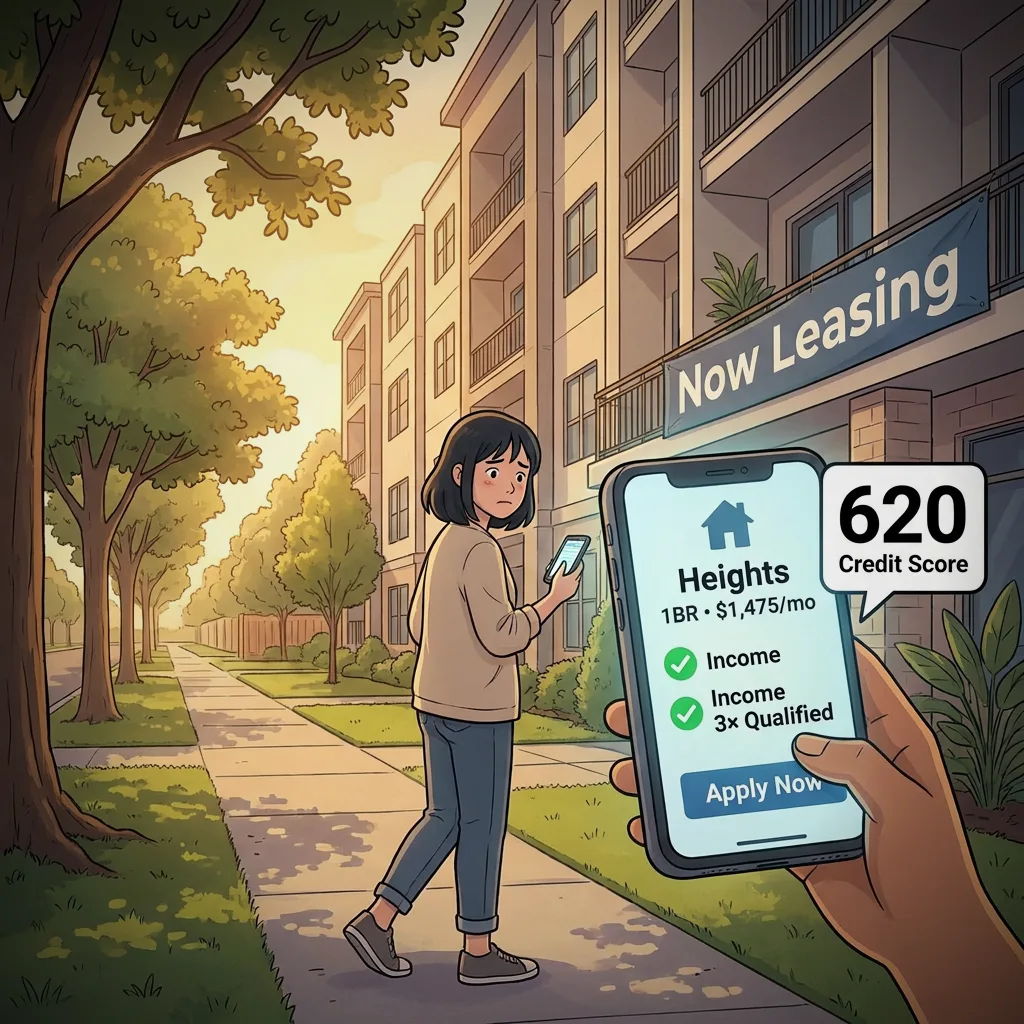
What is the minimum credit score at this property — confirmed by phone to leasing, not from the listing? Most complexes don't publish credit minimums on Zillow or Apartments.com. Call and ask directly: 'What's your minimum credit score for this unit?' If the answer is 650+ and yours is 620, this is the wrong property. Do not apply. Save the $50.
Does this complex offer a deposit override for applicants in the 600–649 range? Ask directly: 'If my credit score is 620 but my income clears 3×, do you have a deposit adjustment option?' Many mid-market Houston complexes have this policy and don't advertise it. The answer determines whether 620 is conditionally approvable or genuinely ineligible at this address.
What is my monthly gross income divided by the listed rent, and what multiplier does this complex require? Standard is 3× — if rent is $1,475 and you earn $4,800, you clear 3× ($4,425 threshold). Some complexes require 3.5× or 4×. Confirm the specific threshold by phone before applying. Strong income can offset lower credit at many Houston complexes.
Do I have clean rental history — no prior evictions, no broken leases in the last 3 years? Clean rental history is often weighted more heavily than credit score at Houston complexes in the 620 range. Ask leasing: 'Does prior rental history factor into approval for applicants near your credit minimum?' A 620 with clean history frequently outperforms a 650 with a broken lease.
Has HTXapt pre-screened this property for my specific profile before I apply? If not, send the address and ask for a quick approval likelihood check. We confirm credit minimum, income ratio, deposit override availability, and rental history weight by phone — before you spend a dollar. The pre-screening conversation is free. The application fee isn't.
How to Qualify in Houston — Income, Credit & Guarantors
Most Houston buildings require you to earn **2.5x–3x the monthly rent** in gross income. If you're renting a $1,600 1BR, that means you need to show $4,000–$4,800/month in verifiable income.
### If you don't meet the income requirement
- **Use a guarantor.** Many buildings accept a parent or family member as a guarantor who earns 4–5x the rent.
- **Combine incomes with a roommate.** A 2BR split between two earners is often easier to qualify for than a 1BR solo.
- **Show savings or offer a larger deposit.** Some buildings will accept 2 months' deposit in lieu of meeting the income ratio.
### Credit score expectations
Most buildings in Houston want a **620+ credit score** for the primary applicant. Some Class-A buildings want 650+. If your credit is lower, a guarantor with strong credit can offset it — but ask the building directly, because policies vary.
Co-Signer & Approval FAQ
If I use Leap or TheGuarantors, does it show up on my credit report?
The guarantor service typically reports as a payment account if you fail to pay them — same as any credit account. Paying on time generally has no negative impact. The service runs a soft pull when you apply (no credit-score impact); the building still runs its own hard pull as part of the standard rental application. Read the specific service's terms — both Leap and TheGuarantors publish them clearly.
Can I combine a guarantor service with the §92.111 fee-in-lieu of deposit?
Often yes — they solve different problems. Path 2 (guarantor) addresses the income/credit screening; Path 3 (fee-in-lieu) addresses the move-in cash wall. The building has to accept both — confirm before applying. Renters with thin files and limited savings frequently stack them.
What if my parents already cosigned my sibling's lease — can they cosign a second lease?
Technically yes, but the cosigner's debt-to-income ratio is now reduced by the first lease's rent obligation. If your parent makes $80,000/year and is already cosigning a $1,500/mo lease for your brother, an underwriter might count $18,000 of that income as already committed. Many cosigners refuse a second lease for this reason. This is exactly when Path 2 (third-party guarantor) becomes the better answer.
I keep seeing 'no credit check apartments in Houston' ads. Are they real?
No. Every legitimate Houston apartment runs a credit check. 'No credit check' ads in Houston are either upfront-fee scams (you pay an 'application processing fee,' the listing disappears) or unlicensed operations with no maintenance, no security deposit accounting, and informal eviction practices. The path forward when you have credit issues is Path 2 (guarantor) or Path 4 (case-by-case screening) — not 'no credit check.'
How long does the second-chance / case-by-case path take?
Longer than standard. A standard Houston application turns around in 24-48 hours. A case-by-case application can take 5-10 business days because the manager is reviewing your full story manually rather than running automated screening. Build extra time into your move-out timeline if you're on Path 4.
What is the cheapest month to rent an apartment in Houston?
The cheapest window is roughly November through February. Demand is lowest, buildings have empty units to fill, and concessions — free weeks or months of rent — are at their most generous. January and February are typically the rock bottom.
Why is summer the most expensive time to rent in Houston?
Job relocations, students, and families all move between May and August. That surge in demand lets landlords hold asking rents at their annual high and pull back concessions, while units turn over in days.
How much can I actually save by timing my lease?
It varies by submarket, but in early 2026 some Houston areas offered up to 2.5 months free, and two months free on a 13-month lease was common. On a $1,400 unit, two free months is roughly $2,800 off your first-year cost.
Does a 13- or 15-month lease really help?
Yes — two ways. It often carries a lower monthly rate than a 12-month term, and it shifts your renewal date into the off-season, so you re-negotiate from the cheaper, lower-demand side of the calendar instead of mid-summer.
My lease ends in July. What should I do?
You don't have to move at the peak. Ask your landlord for a short extension (a few months, often month-to-month or a custom term) to push your search into the fall or winter, then sign your next lease in the cheap season.
Is 620 credit actually enough for Houston apartments?
At most standard Houston mid-market complexes, yes — with conditions. 620 is in the conditional approval zone: approvable at complexes with flexible policies (deposit override, income ratio override, or co-signer option). It is NOT approvable at properties with hard 650+ cutoffs. The difference is the property, not the credit score. HTXapt pre-screens credit minimum at every property before it appears on your shortlist — if a property requires 650+ and yours is 620, it won't appear. The shortlist you receive contains only properties with a real approval path for your profile.
I got rejected once with 620 credit. Does that rejection follow me to future applications?
The rejection itself doesn't follow you — it's not reported to credit bureaus and doesn't appear on rental history checks. What CAN affect future applications is the hard credit inquiry from each application: each hard pull adds a small negative factor to your credit score (typically 2–5 points, temporary). Multiple applications in a short window compound this. This is another reason pre-screening matters — every application to the wrong property costs $50 AND a small credit dip. Shortlisting only pre-screened Likely/Conditional properties reduces unnecessary hard pulls.
What if I apply to a pre-screened 'Likely' property and still get rejected?
Pre-screening is a calibrated probability, not a guarantee. If HTXapt labeled a property Likely and you got rejected, we want to know: we'll follow up with the leasing office to understand the basis, confirm whether the criteria we had were accurate, and update our placement data for that property. This happens occasionally — a new leasing agent applies a stricter interpretation, a building changes management, or an individual decision overrides stated policy. When it does, we rebuild the shortlist at no cost and flag the property for recalibration.
What if my income barely clears 3× alongside a 620 credit score?
Income right at 3× combined with 620 credit is a tighter profile, but manageable. The key is property selection: some complexes treat income and credit as independent thresholds (meet both, approved); others use a combined scoring model (strong income can offset lower credit). HTXapt pre-screens for which model applies. If your income is $4,425 and rent is $1,475 — exactly 3× — we'd shortlist properties where income-at-threshold is sufficient and flag properties where the combined model makes it tighter. You'd see this in the Likely vs. Conditional labeling.
What if I have more complications beyond credit — a broken lease or prior eviction?
Broken lease and prior eviction are separate from credit score and weighted differently by different complexes. A broken lease 2+ years ago is often overlooked at mid-market Houston complexes with a written explanation and strong current income. A prior eviction in the last 3-5 years is more serious — most standard complexes won't approve, but private landlords and some boutique properties have more flexible policies. When you DM HTXapt, tell us everything: credit, income, full rental history. We match the profile to the property, not the other way around. There are always options — the question is which specific inventory fits your specific profile.
The rejection isn't the end. It's the moment most renters reach for the only path they know — and 3 better paths sit unused. The $1,200 cosigner-saved-the-day story everyone has heard? It's also the story where the cosigner is on the hook for $4,200 next time you can't make rent. That's why Path 1 is the worst of 4 paths — not because it never works, but because it asks the most of someone else when 3 paths exist that don't.
Houston Apartment Rejection, Apartment Cosigner, Lease Guarantor, Texas SB 1783, §92.111 Fee in Lieu, Leap Guarantor, TheGuarantors, Second Chance Apartments Houston, Maya OA Arc